What is it – with regards to acquiring your first language (L1)?
Behaviourism is a theory of learning based on the idea that all behaviours are acquired through
conditioning, and conditioning occurs through interaction with the environment.
Infants learn oral language from other humans through a process involving imitation, rewards and
practice. The human role models in an infant’s environment provide the stimuli and rewards (Cooter& Reutzel, 2004).
The child will learn the speech patterns through imitation from interacting with people around them.
The child will then get praised and get affection for their efforts which becomes then the reward.
How may this theory be visible in a TESOL (L2) classroom; teacher activity/what is the teacher doing?
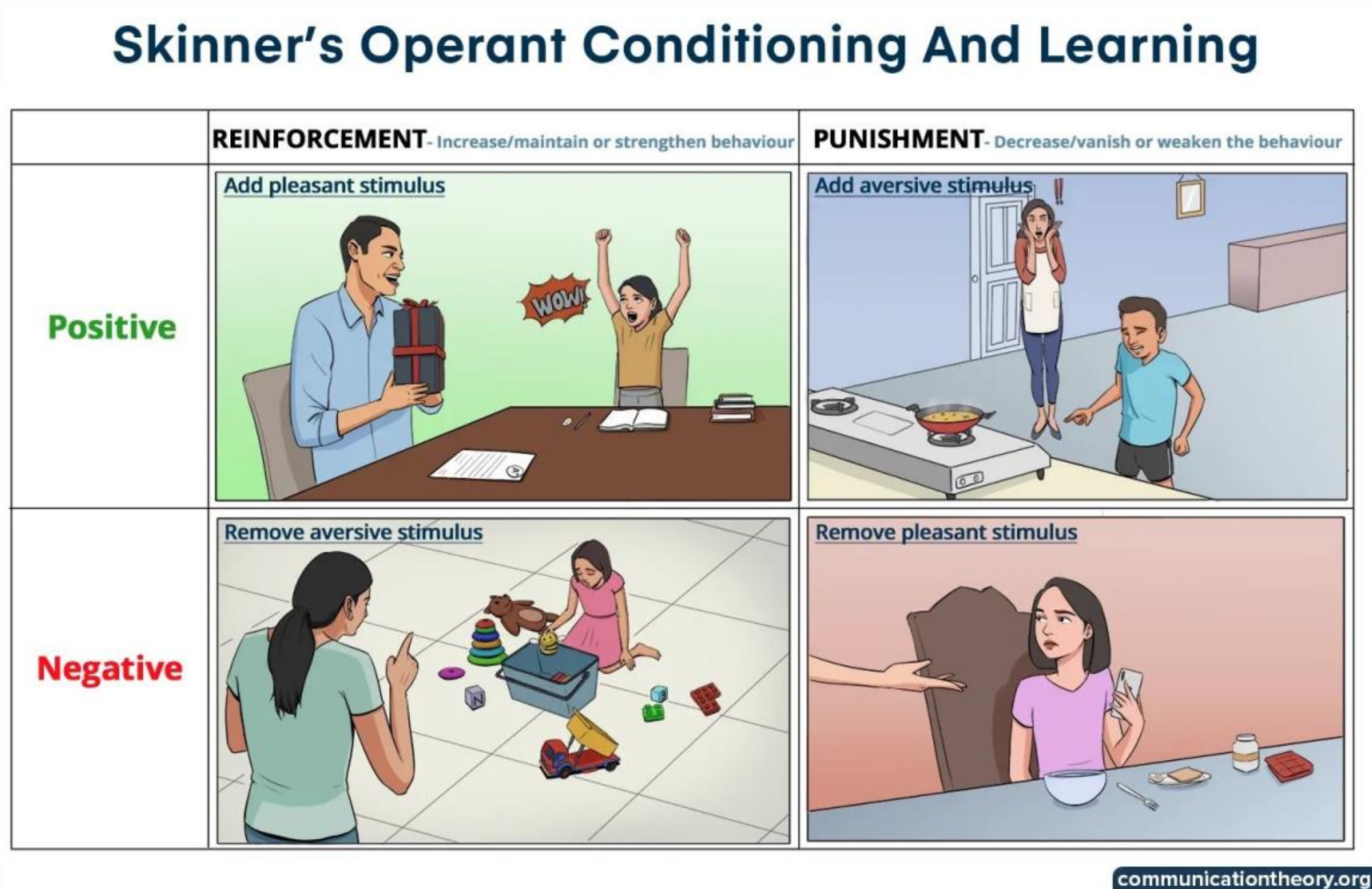
The teacher might give rewards or praise the students when
they gave the right answer by giving positive feedback.
Is there a language teaching approach associated with this theory?
Skinner drew attention to the importance of rewarding parts of acts when learning complex
behaviour. He called this systematic creating of behaviour aided by operant conditioning shaping.
Skinner’s original ideas led to the development of the programmed learning theory: comprehensive
and detailed learning programmes students had to follow in stages. The idea was to let the students
make progress in small increments and to reward them frequently with positive feedback, resulting
in an effortless way of learning.
Influential researcher: Skinner.
classical conditioning, a concept described by Russian researcher Ivan Pavlov, with its two related
dynamics as described by American behaviourist Edward Thorndikei.
operant conditioning, which became known through the experiments of American behaviourist
Burrhus Skinner.
Skinner focussed on consequences (learning through consequences).
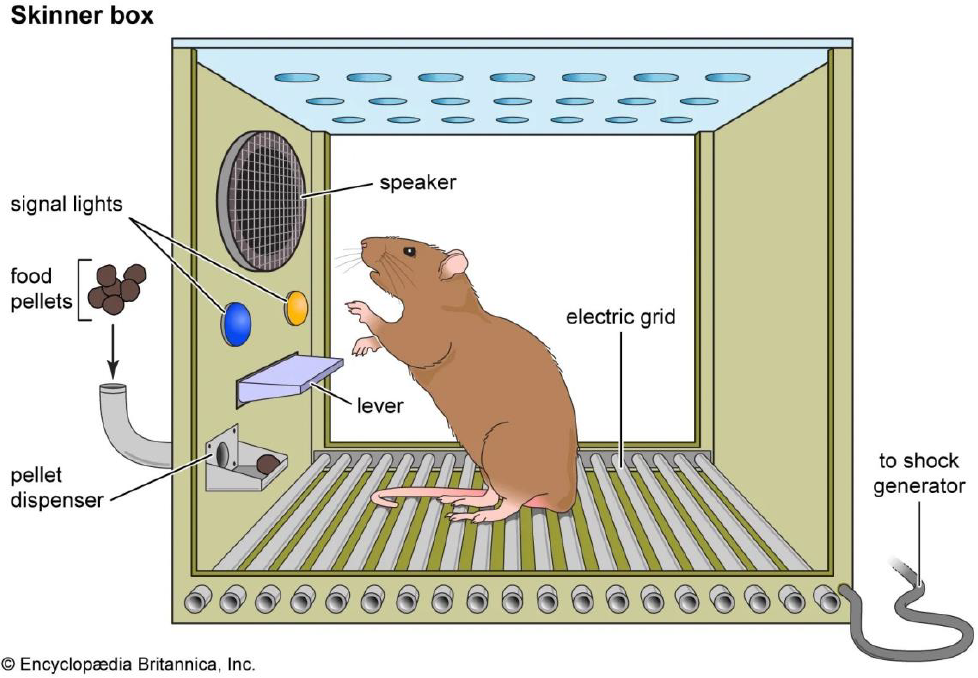
As a professor of psychology at Harvard University from 1948 (emeritus 1974), Skinner influenced a
generation of psychologists. Using various kinds of experimental equipment that he devised, he
trained laboratory animals to perform complex and sometimes quite exceptional actions. A striking
example was his pigeons that learned to play table tennis. One of his best-known inventions, the
Skinner box has been adopted in pharmaceutical research for observing how drugs may modify
animal behaviour.
Conditioned pigeons and then he fired a pistol next to their heads to see if loud noise would disrupt
their pecking. He put the pigeons in a pressure chamber, setting the altitude at 10,000 feet. The
pigeons were whirled around in a centrifuge meant to simulate massive G forces; they were exposed
to bright flashes meant to simulate shell bursts. The pigeons kept pecking. They had been trained,
conditioned to do so.
Criticisms of the theory
If rewards would not be given would the development in language of a child stop?
Learning the meaning of abstract words or how to use them is evidence of forms of language not modelled by others.
– according to behaviourism, only controlled lab experiments, the standard in natural sciences, were seen as reliable enough to turn psychology into genuine science.
-Behaviourists are convinced that human and animal behaviour can be predicted and controlled
– One of the founders of behaviourism, John Watson, stated that any infant can grow up to be an artist, businessman or beggar if he is raised in a corresponding environment with matching stimuli.
References:
(Page 15, HLAL)
(Teachers Handbook Ch. 1.4)